So it's been a year since the Pacific Cup and I never posted a race report! This blog was for class credit and with school over for the summer and a mad rush to get ready for the race, it fell to the way side. So here is the race report I wrote for Sailing Anarchy:I woke up around 9:00 a.m. on July 5, 2010 in a blind panic. Cody and I had been working on Furthur until 5 a.m. the morning of our start and a one hour nap at a friend's house became a two and a half hour nap. Now we were seriously at risk of being late to the start. Luckily, we were mostly packed up and ready to go. After crazy drive from Sausalito to Richmond Yacht Club, Cody and I said goodbye to our friends and family, hoisted our new Ullman main for the first time, and set off for the starting line. In true Team Furthur style, we were about 30 minutes late to our start, but with 2070 nautical miles of race course ahead of us we took on the attitude of "better late than never" and charged under the Gate in the wake of our fleet.
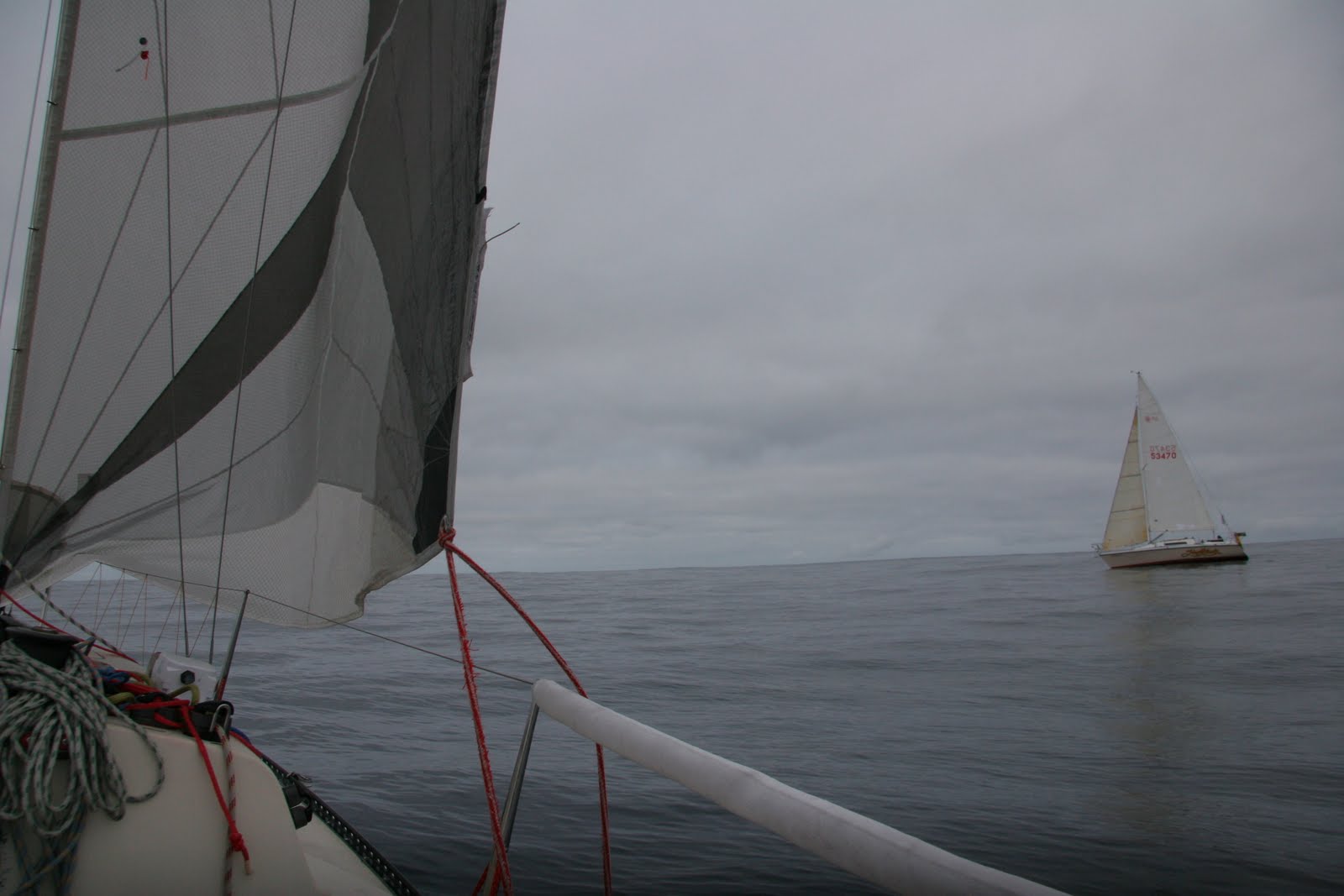
As we headed out, the breeze continued to die and we changed from the #4 jib to #1 genoa. After the Farallon Islands, it started looking like a very long race. With a huge low sitting over the California coast, the wind evaporated and we began drifting for Hawaii. The wind got so light at times that the #1 would just collapse and it was faster to tie the clew of the #3 to the mast step and let the boat paddle forward in the huge, long period swells than try to sail.

The SC27 has a very heavy, beefy mast, and each set of waves would make the boat rock so badly any flow over the sails and foils would be lost. As I figured out the weather fax program, it became obvious that the usual "go south for more breeze" route would lead to doom and unmitigated failure. Instead, we would have to head west to pick up a wind band that we would eventually ride all the way to Hawaii. While I was trying to get my head around this and forget everything I had learned about navigating the Pacific Cup, an albatross came out of the no where, circled Furthur three times, then flew west. That sealed the deal about which way we would go.

By day 5 we were reaching with the #3 and a reefed main and on day 6 we finally had breeze at the correct angle for Hawaii and set the "Max Runner" spinnaker. The clouds parted for a few hours, Santa Cruz 27 was sliding down the wave faces in true West Coast style, and we had finally begun our sleigh ride to Hawaii. Our goal was to catch our friends on Moonshine, who we nicknamed the Gypsies (think Borat) for the duration of the race. Even though we owed them time, Moonshine had just launched off the start and was leading the Doublehanded 1 fleet.

The first night of surfing with the kite up was just a taste of what was to come: constant cloud cover and no moon. It would prove to be a very dark race.
The upside was everything on board was working except for the battery charger, but with such a small electrical load and large batteries we could make it to Hawaii without running out of juice. Our instruments consisted of 2 handheld GPS's, a compass that was almost impossible to read at night, and the Windex which was perfectly illuminated by the LED masthead tricolor. Around 9 knots, the boat suddenly feels like it is on rails. The helm is lightly loaded and precise, almost like it has power steering. The faster she goes, the better she feels, but the steering groove gets more and more narrow. As our top speed records climbed into the high teens, Furthur stayed true to her roots and felt just like a mini-sled. Linking surfs between multiple waves became common, though it was very physically tiring. Before the race, I installed two clutches and cheek blocks for the spinnaker sheets, allowing the guy to be clutched off and the spinnaker sheet cross-sheeted to the weather cockpit winch. As the boat came over the top of a swell, the driver would pump the vang to initiate the surf, then steer down the face while "banjoing" the spinnaker sheet to keep the kite full and give a little more power from a pump (if it wasn't too highly loaded). Steering up to stop the bow from burying into the back of the next wave and keep some some heat on to climb over it, you would have to ease the vang to unload the rudder and help keep the bow up while also easing any banjoed spin sheet as the apparent wind shifts aft. Let the boat climb over the back of the next wave and repeat the cycle. Wave after wave, mile after mile, 2 hours on watch, 2 hours off watch.


Our max speed during the race (the fastest I've ever gone on a sailboat) was 20.7 knots and I was driving in total darkness. Furthur no longer felt like a sled, instead she was bow up and flat out planning like a sport boat. The waves were about 12 feet and the only warning of their presence was the glow bioluminescene and the sound as their crests broke. Then the bow would drop like the start of a roller coaster ride, the bow wake breaking well aft of the shrouds and as high as the boom on both sides, creating a bioluminescent tunnel. Approaching the trough, the bow wake would slide all the way forward to the headstay fitting, spray still flying away from the boat in a giant white-green V. The groove became so narrow there was no way to drive for two hours straight without the risk of a serious wipeout and carnage, so Cody and I decided to downshift to the #3 poled out. We were still surfing in the mid teens and headed DDW straight for the finish. At dawn we reset the spinnaker, knowing we may have lost some ground but succeeded in keeping the boat in one piece.
The only really bad crash we had was between two squalls at twilight. I had been on watch for about 15 minutes when I felt the tale-tale cold air of a squall. Right as the pressure came on, I dropped in on the steepest wave of my life. It honestly lifted my stomach like going over a bump in a car at speed. The SC27 has really low freeboard and a rather narrow bow compared to other ULDB's; we were used to the foredeck occasionally being covered in green water. On this wave we just augered straight into the bottom of the trough. Completely blowing the vang usually unloaded the boat enough for the bow to pop up. This time it had no effect whatsoever. Immediately blowing the spin sheet completely off the winch as I started standing more on the aft bulkhead of the cabin than sitting in the cockpit, I felt the helm go light as a foot of water rushed over the cabintop. The foredeck was 6-8 feet underwater and I assume the rudder came completely out of the water. [i]Furthur[/i] stood on her nose, then fell over sideways in an epic, masthead-hitting-the-water round up. Everything was eased and I tried pumping the rudder to get the boat back under the mast, but I'm pretty sure the rudder was still out of the water. Between me yelling "Fuck fuck fuck this is not good!" and the water pouring over the cabin top, Cody popped out of the companionway right as the rudder caught a wave and we were whipped into a round down. The boom and mainsheet block missed Cody's head by an inch as the boom gybed. Everything was cluster-fucked on the port side of the boat (we were running on port pole), but we gybed back and tried to get the kite under control. This proved futile in the middle of a squall, so we ran under main only and cleaned up the mess. Amazingly, nothing broke during this almost pitch-pole wipeout. This is truly a testament to the design and build quality of the old Santa Cruz Yachts. As newer boats broke and retired or had to limp to Hawaii, this a 30 year old, structurally stock SC27 just took a beating and kept on hauling ass.

Our only real breakage happened in one night when the wiring for the masthead tricolor at the mast base got corroded and the tricolor went out. This is the only way to see the windex at night, so Cody had to drive through a sqaull in total darkness while I tapped a flashlight to the backstay. Then the wire bridle on our spare aluminum pole broke (the carbon pole's center lashed D-ring was slipping and I was in the process of making it a new bridle), so I just attached the foreguy and topping lift to the pole end. Lastly, the tiller headstock had started slipping on rudder post and it took all my strength to torque down on the bolt with a set of vice grips.
By this point of the race, it was obvious that Moonshine had run away with the bullet in our division and it became a fight for second place between us and the Cal 40 Nozomi. Though 13 feet longer than us, we owed them 3 seconds a mile, which works out to 1 hour 43 minutes over 2070 miles. Nozomi was still leading us; Cody and I knew that we would have to hard all the way to the finish in order to correct out ahead of them. That 30 minutes lost at the start was beginning to weigh heavily on our minds. It was a drag race to the finish and we concentrated on maximum speed and VMG, while keeping the boat in one piece. Coming into the finish at 1 am, we knew it would be neck and neck. Nozomi was still out there, but how far back were they? 30 minutes? 3 hours? We ended up too busy after the finish to even have a chance to sweat it out.

On the second to last day of the Pacific Cup, I noticed about a foot of bolt rope had pulled out of the mast track and the rest of the main was at risk of zippering out of the mast track. Armed with some Dyneema and a climbing harness, I climbed while Cody steered and tailed me up the rig. With the headboard lashed around the rig, the main couldn't pull out any more. It also couldn't be lowered without another trip up the rig. I had this all planned out for after the finish, but I wasn't expecting to finish in the dark and suddenly be so disoriented with some many lights after almost two weeks at sea. Our escort boat was late, but we had our own problems to deal with. After dropping the kite, Cody reached off and I went up the rig one last time to free the main. Right as I touched back down on the foredeck, Cody yelled "Was that a breaking wave?!?" Still tied to a halyard, I dove for the GPS in the cockpit. We were in 8 feet of water on the windward side of the famous Kaneohe Bay sandbar. Cody headed up quickly as I whipped in the mainsheet, but we had to sail out and a round several sets of breaking waves. Once we were able to find our escort boat, we began what seemed like the longest sail up the Sampan Channel. We were required to motor into the harbor as part of the safety inspection, so after wrestling the heavy 6hp Tohatsu from its cave under the cockpit we completed the final leg of our voyage to the dock. Furthur passed her post-race inspection with flying colors, and when Cody and I stepped onto the dock after racing for 13 days and 17 hours I felt like we had just summited Everest. We were the youngest crew to have ever raced in the Pacific Cup and in 2nd place in the DH1 division. Nozomi finished about three hours after Furthur, allowing us to correct out just in front of them.

The 2010 Pacific Cup was the most fun I have ever had sailing. There is nothing better than a 2000+ mile sleigh ride in a light boat with one of your best friends! I'd like to thank everyone who helped Team Furthur achieve this record and podium finish.
Specifically:
My boss and friend Brian Malone, who backed my hair-brained scheme from the beginning and helped me gather support. He is the owner Speed Merchant Services, a mobile rigging company, and gave me the industry discount on parts before I was even his employee. He also taught me almost everything I know about rigging, which was crucial in the refitting and preparing of Furthur for Pac Cup.
His wife Kat is also amazing, she helped organize a fundraiser for us at the Davis Island Yacht Club in Tampa and was my professor for a documentary blog I kept about this project as an independent study at college.
Everyone at DIYC who helped us along the way, whether lending us tools, buying my photographs at the fund raiser, or just giving some words of advice and praise.
Chuck Skewes and the Ullman Sails San Diego Loft. Cody and I met Chuck in Hawaii after doing the 2008 Pacific Cup on a Henderson 30. Almost everything broke, we got last place, but he recognized our accomplishment and what we had learned through the ordeal. When we told him the beginnings of our plan to do the race double-handed in 2 years, he promised us a killer deal on sails. True to his word, he built us great sails at a great price. When our only new spinnaker being made of donated cloth wasn't going to be ready in time, Chuck used the combined forces of several Ullman lofts to build us a kite in 24 hours! Truely awesome! His friend Andy of Northwest Rigging and a fellow SC27 owner also lent us a 3/4oz kite for the race, which we used quite a lot.
Patrick aka Stinky of Santa Cruz Sails for offering to build us a spinnaker for free if we could find someone to donate us the cloth. The dude didn't even know us, but went out of his way to help us before the race. Ultimately, the cloth came too late for him to build us a kite before the race, but he is still putting it together free of charge this winter. Thanks man!
Jeremy Leonard of Surf City Racing for sponsoring us the spinnaker cloth. Even though it came too late for us to use in the race, it was still such a generous offer in this economic recession. Jeremy is a great guy, a true anarchist, and I can't wait to bust out the Surf City Racing kite!
Doghouse, who lent us his satellite phone and all the necessary equipment to make it work and be race legal! Thank you!
Wash, who lent us his liferaft. He even dropped it off to us at RYC on SF Bay, but he lives in Long Beach. We could not have done the race without this crucial piece of safety equipment.
All of my friends, especially Sheehan and Michael. Sheehan put up with a lot of my bullshit getting the boat ready for this race, but she still flew up from her summer job in San Diego to help Cody and I get Furthur ready in the mad pre-race scramble. Tweek has been there for Team Furthur for a long time, from letting us crash at his place, convoying across the country, and towing the trailer down to SoCal for last minute shipping arrangements. Thank you all!
Rob and Rowena of Nozomi, thanks for the great competition on the water and great drinks in Hawaii!
Dylan and Rufus, the crew of Moonshine, who shared as many of their Gypsy secrets with us as they could. If it wasn't for your suggestion of bringing a spinnaker net, we would have destroyed every kite before we got half way.
Synthia of Santa Cruz Sails, for loaning us her storm sails and spinnaker net. She's done several Pacific Cups, from DH on her Hawkfarm 28 to fully crewed on a Schummacher 50.
My parents, for teaching me so much about the water, putting up with a project boat squeezed next to the house for 2 summers, being my shore team, and helping me get to the starting line.
 -Being in the back of the boat. I usually do bow, and was a little disappointed to be so far from the foredeck. But this meant I got to overhear all of the tactics and strategy in the back of the boat. And when Jay Crumb (strategist) and Jeff Thorpe (tactician) talk, you listen. Being the smallest boat in the IRC A division (but owing a 73 foot boat time around the course) and being offshore optimized with a light keel and no grinding pedestal for the mainsheet meant that the strategist and tactician had to put the boat in the perfect position on the bay in order to keep from being shot out the back of the fleet. Jay Crumb answered all of my questions and I learned a ton about playing the tides in San Francisco Bay, as well as the communication in the back of a Grand Prix boat. Plus, it was awesome how Rodney could call puffs, identifying the wind shift with a perfect count down to breeze on.